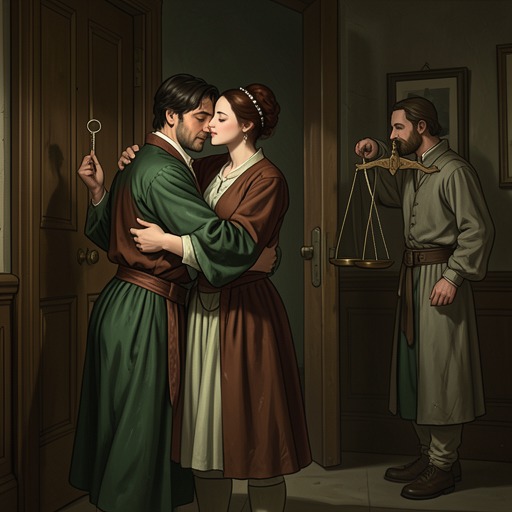
There are two types of husband and wife
CEO's Beloved Honey Girl“There are two types of husband and wife” is a relationship formula articulated by Chu Fei to Su Xiangwan: one marriage promises life and death and loves with consuming intensity; the other is founded on respect and shared living. Its decisive importance lies in the contrast between romantic extremity and sustainable companionship, a contrast sharpened by the coercion, jealousy, financial bargaining, and unstable loyalties elsewhere in the story.
Definition and Immediate Context
The expression appears during a private conversation in which Chu Fei tries to interpret Su Xiangwan’s marriage to Lu Xun. Chu Fei initially believed that the couple might belong to the second type, a pair able to respect one another and live together without demanding dramatic emotional fusion. He then revises that judgment: Su Xiangwan and Lu Xun are young and impulsive enough to pursue the first type, turning marriage into an all-or-nothing emotional struggle rather than a measured partnership.
Su Xiangwan’s response gives the distinction its psychological force. She calls herself foolish, says that she has made her life a mess without understanding what happened, and admits that even after returning to the old residence to live peacefully, her heart cannot settle. Her difficulty is therefore not simply a choice between two abstract marital models. The calm domestic arrangement Chu Fei recommends is unavailable to someone whose attachment remains emotionally unsettled, while the passionate model threatens to intensify the very turmoil from which she wants to flee.
The Two Marital Models
The first model is defined by total emotional commitment: spouses promise life and death and love one another to the point of excess. In the novel’s surrounding conflicts, this ideal is not presented as harmless romance. Lu Xun’s marriage to Su Xiangwan is entangled with a five-hundred-million contract, her attempt to seek a divorce without property or alimony, and her proposal to convert his capital into shares and return it with interest. Marriage thus carries both emotional claims and material leverage. The language of absolute attachment can promise devotion while existing beside control and unequal power.
The second model is quieter and more pragmatic. Its central actions are respect and continued life together, rather than emotional conquest. Chu Fei says that it may not be soul-stirring, but it is at least beneficial to body and mind. His argument treats marital stability as a form of care: a relationship need not reproduce crisis in order to be real, and emotional restraint may protect the people within it better than dramatic possession can.
The expression also exposes a conflict between marital name and marital conduct. Lu Xun can be recognized as Su Xiangwan’s husband, and Su Xiangwan herself identifies him as such while intoxicated, yet the title does not settle whether their relationship is respectful, secure, or freely chosen. The story repeatedly places the word husband beside threats, suspicion, and demands for loyalty, making the distinction between the two types a test of what marriage actually consists of rather than a celebration of the title alone.
Contrast with the Story’s Other Relationships
The formula gains breadth through the surrounding network of relationships. Song Yun’er describes herself as abandoned and argues that she has already received her retribution, while Lu Xun responds with cold humiliation. Their exchange presents intimacy as accumulated grievance, with past choices converted into emotional debt. In another relationship, Lin Yanche threatens Su Qingrou with harm to Jin Zhengnan if she leaves the manor, then uses sexual jealousy and accusations of disloyalty to keep her under pressure. These marriages and attachments resemble the first model only in their intensity; they lack the mutuality that would make passion protective rather than coercive.
The story also shows how physical vulnerability alters the meaning of marital care. Su Xiangwan becomes feverish after sleeping without enough covering and must ask Manager Wu to buy antipyretic medicine. Later, Mo Beiyu condemns Lu Xun for torturing his woman until she faints by the roadside and calls him a rapist, while the police arrange to return Su Xiangwan to her family. In this context, Chu Fei’s claim that one form of marriage benefits body and mind reads as a direct ethical counterpoint to relationships in which possession produces bodily danger.
Questions of kinship further complicate the distinction. Shen Yiyun is introduced as Lu Xun’s cousin through adoption rather than blood and has been given lodging near the theater. Lu Xun’s family defends the relationship through the language of kinship, while Su Xiangwan challenges the confidence that such a label should automatically eliminate suspicion. Chu Fei likewise tells Lu Xun that a supposed close relative once appeared to him in that role but was not actually related to him, and that he liked her deeply. The expression therefore belongs to a narrative where marriage, family, adoption, and desire repeatedly overlap, making respect depend on clear boundaries rather than names alone.
Emotional Choice and Narrative Significance
Chu Fei’s distinction is not a neutral taxonomy. It is offered as counsel to a woman who says she wanted to love Lu Xun but did not dare, wanted to run but could not. His response gently shifts from tension to consolation, and he pats her shoulder as if both comforting her and giving her strength. The advice recognizes that Su Xiangwan’s attachment has become a pursuit-and-escape loop: she longs for distance, yet peaceful distance does not restore her equilibrium.
The expression also explains why Su Xiangwan cannot simply choose safety by force of will. A respectful marriage would require more than a change of residence or the formal return of money. It would require a different structure of intimacy, one in which neither spouse treats the other as property, punishment, proof of loyalty, or compensation for past injury. Conversely, the life-and-death model carries the promise of absolute belonging but risks making separation, disagreement, and bodily autonomy appear as betrayals.
As a recurring idea, “There are two types of husband and wife” gives the novel a compact vocabulary for judging its romantic plots. It contrasts dramatic love with livable love, status with conduct, and pursuit with peace. Its force comes from the fact that Su Xiangwan’s life cannot yet inhabit the second model: she returns to family shelter, considers escape, and still finds that her heart remains attached. The expression consequently functions less as a settled answer than as a standard against which the characters’ marriages, threats, reconciliations, and claims of love are measured.